Cheap Dopamine vs Real Dopamine: Brain Reward Explained
Understand the difference between “cheap” and real dopamine, how the brain’s reward system works, and what drives motivation, habits, and long-term satisfaction.



Dopamine is being misunderstood as always being the pleasure hormone. In neurobiology, it is more accurately depicted as the motivational neurotransmitter.
It doesn’t just provide a sense of happiness and pleasure. It activates reward prediction, reinforcement learning, and goal-oriented behavior.
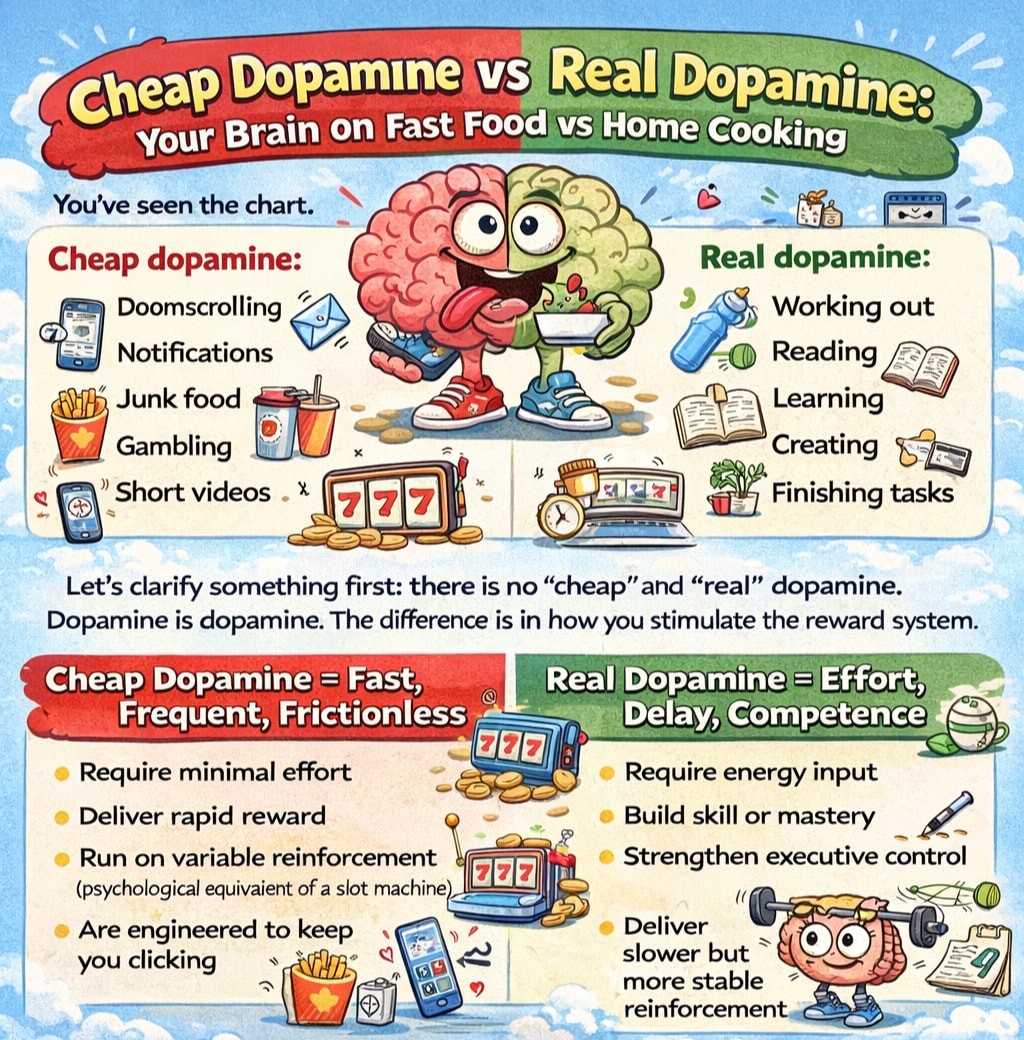
There is no differentiation at the molecular level when we talk about cheap and real dopamine. It refers to the amount of effort required to attain the release of this substance.
Understanding this difference is critical for long-term productivity, mental health, and behavioral resilience.
Dopamine, also known as 3,4-dihydroxytyramine, is a neurotransmitter that is produced primarily in:
Ventral tegmental area (VTA)
Substantia nigra
Hypothalamus
Key pathways include:
Mesolimbic pathway – reward and reinforcement
Mesocortical pathway – cognition and executive function
Nigrostriatal pathway – motor control
Activation of canonical dopamine neurons has a rewarding effect—it increases the frequency of actions that lead to their activation
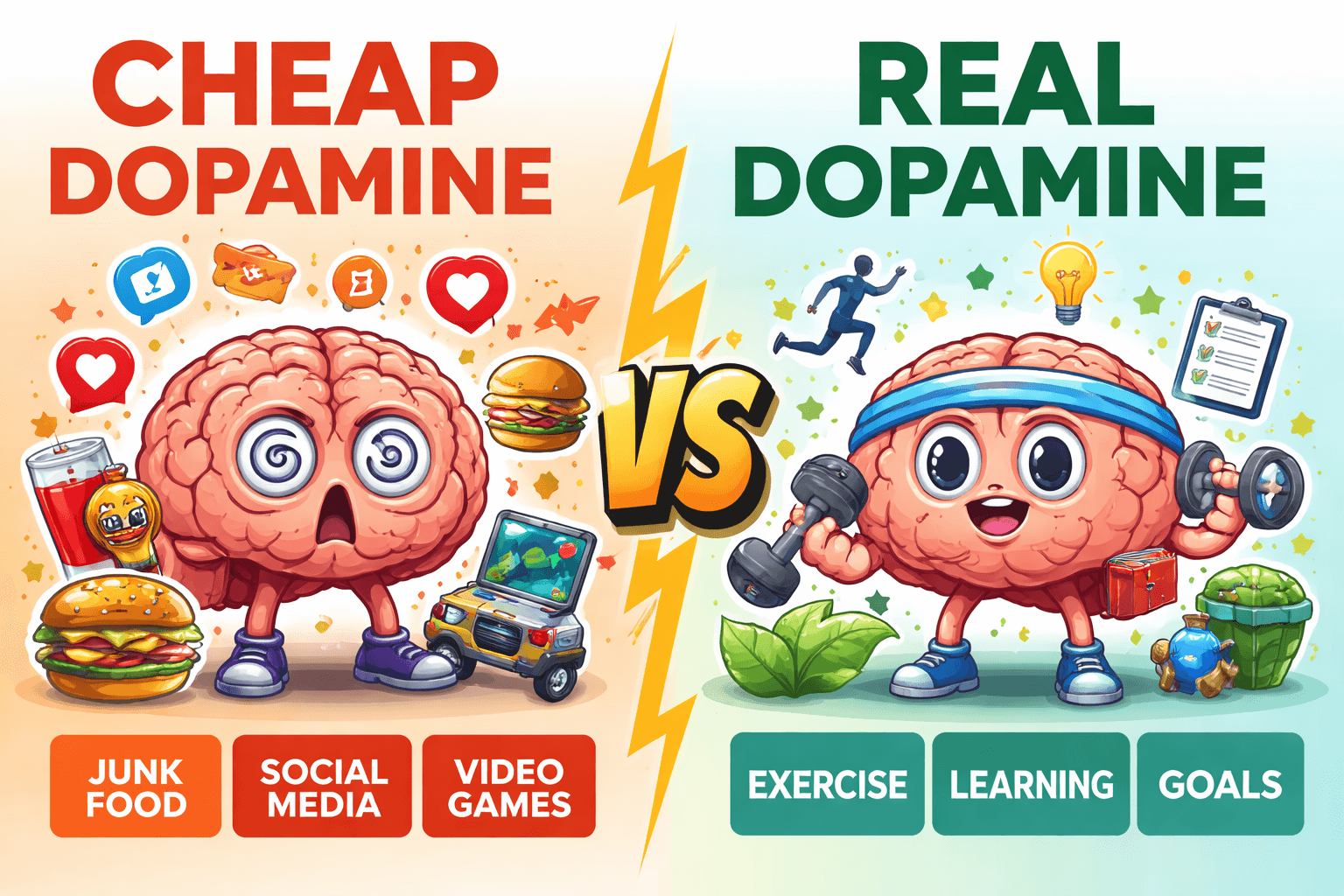
‘Cheap dopamine’ refers to high-frequency, low-effort, instantly gratifying stimuli that result in a burst of dopamine release without any delay
Watching reels
Eating junk food
Winning lotteries and games
Online shopping
These activities:
Produces a rapid and excessive dopamine surge
Requires minimal to no effort
Develops a sense of dependence and addiction
Over time, repeated high-frequency stimulation can lead to:
Reduced dopamine receptor sensitivity (downregulation)
Increased tolerance for dopamine release
Decreased motivation
Impaired focus
Reduced memory power
“Real dopamine” refers to dopamine release generated from effort-based, goal-oriented, meaningful activities.
Excercising
Reading books
Completing tasks
Creative works
These activities
Produce Moderate but adequate dopamine release
Requires some amount of effort to obtain dopamine release
Strengthens long-term reward system
Improves functioning and creative mindset
Improves focus
Activates hippocampus to store activities as long-term memories.
Promotes sustained motivation
Cheap Dopamine | Real dopamine | |
|---|---|---|
Reward timing | Immediate | Delayed |
Efforts required | Minimal to none | Moderate to high |
Sustainability | Low | High |
Frequency | High | Low |
Motivation | Decreased baseline of motivation | Builds long-term drive |
Outcome | Short-lived pleasure | Long-lasting satisfaction |
The problem is not when it occurs occasionally. When continuous long-term exposure to such dopamine occurs, it leads to
Increased procrastination
Reduced attention span
Anhedonia (reduced ability to feel pleasure)
Higher impulsivity
Decreased tolerance for discomfort
Everything feels dull
Requires an excessive amount of dopamine release to feel even a little gratification
Constant dependency and addiction to cheap Dopamine activities
Some may even end up with withdrawal symptoms if left unnoticed.
Recently, the term ‘Dopamine fasting’ or ‘Mind detox’ has gained popularity. It refers to temporarily avoiding such cheap-dopamine activities to rewire the brain to function normally.
Though it cannot be a permanent solution, it could help to reduce overstimulation and promote long term effects if done correctly.
Instead, you should try to
Reduce high-frequency reward activities
Effort-based reward
Normalize discomfort
Cheap dopamine is engineered for repetition. Real dopamine is earned through effort, progress, and mastery.
The long-term health of your reward system depends not on eliminating pleasure, but on balancing instant gratification with purposeful challenge.
If your baseline motivation feels low, examine not your ambition, but your inputs.
Salamone, John D., et al. “Mesolimbic Dopamine and the Regulation of Motivated Behavior.” Behavioral Brain Research, vol. 137, no. 1–2, 2002, pp. 3–25. Elsevier, https://www.sciencedirect.com/science/article/pii/S0166432802002359.
Berridge, Kent C., and Terry E. Robinson. “What Is the Role of Dopamine in Reward: Hedonic Impact, Reward Learning, or Incentive Salience?” Brain Research Reviews, vol. 28, no. 3, 1998, pp. 309–369. Elsevier, https://www.sciencedirect.com/science/article/pii/S0165017398000195.
Hamid, Anna A., et al. “Mesolimbic Dopamine Signals the Value of Work.” Nature Neuroscience, vol. 19, no. 1, 2016, pp. 117–126. Nature, https://www.nature.com/articles/nn.4177.
Gardner, Matthew P. H., et al. “Rethinking Dopamine as Generalized Prediction Error.” Proceedings of the Royal Society B, vol. 285, no. 1891, 2018, https://royalsocietypublishing.org/doi/10.1098/rspb.2018.1645.
Dopamine is being misunderstood as always being the pleasure hormone. In neurobiology, it is more accurately depicted as the motivational neurotransmitter.
It doesn’t just provide a sense of happiness and pleasure. It activates reward prediction, reinforcement learning, and goal-oriented behavior.
There is no differentiation at the molecular level when we talk about cheap and real dopamine. It refers to the amount of effort required to attain the release of this substance.
Understanding this difference is critical for long-term productivity, mental health, and behavioral resilience.
Dopamine, also known as 3,4-dihydroxytyramine, is a neurotransmitter that is produced primarily in:
Ventral tegmental area (VTA)
Substantia nigra
Hypothalamus
Key pathways include:
Mesolimbic pathway – reward and reinforcement
Mesocortical pathway – cognition and executive function
Nigrostriatal pathway – motor control
Activation of canonical dopamine neurons has a rewarding effect—it increases the frequency of actions that lead to their activation
‘Cheap dopamine’ refers to high-frequency, low-effort, instantly gratifying stimuli that result in a burst of dopamine release without any delay
Watching reels
Eating junk food
Winning lotteries and games
Online shopping
These activities:
Produces a rapid and excessive dopamine surge
Requires minimal to no effort
Develops a sense of dependence and addiction
Over time, repeated high-frequency stimulation can lead to:
Reduced dopamine receptor sensitivity (downregulation)
Increased tolerance for dopamine release
Decreased motivation
Impaired focus
Reduced memory power
“Real dopamine” refers to dopamine release generated from effort-based, goal-oriented, meaningful activities.
Excercising
Reading books
Completing tasks
Creative works
These activities
Produce Moderate but adequate dopamine release
Requires some amount of effort to obtain dopamine release
Strengthens long-term reward system
Improves functioning and creative mindset
Improves focus
Activates hippocampus to store activities as long-term memories.
Promotes sustained motivation
Cheap Dopamine | Real dopamine | |
|---|---|---|
Reward timing | Immediate | Delayed |
Efforts required | Minimal to none | Moderate to high |
Sustainability | Low | High |
Frequency | High | Low |
Motivation | Decreased baseline of motivation | Builds long-term drive |
Outcome | Short-lived pleasure | Long-lasting satisfaction |
The problem is not when it occurs occasionally. When continuous long-term exposure to such dopamine occurs, it leads to
Increased procrastination
Reduced attention span
Anhedonia (reduced ability to feel pleasure)
Higher impulsivity
Decreased tolerance for discomfort
Everything feels dull
Requires an excessive amount of dopamine release to feel even a little gratification
Constant dependency and addiction to cheap Dopamine activities
Some may even end up with withdrawal symptoms if left unnoticed.
Recently, the term ‘Dopamine fasting’ or ‘Mind detox’ has gained popularity. It refers to temporarily avoiding such cheap-dopamine activities to rewire the brain to function normally.
Though it cannot be a permanent solution, it could help to reduce overstimulation and promote long term effects if done correctly.
Instead, you should try to
Reduce high-frequency reward activities
Effort-based reward
Normalize discomfort
Cheap dopamine is engineered for repetition. Real dopamine is earned through effort, progress, and mastery.
The long-term health of your reward system depends not on eliminating pleasure, but on balancing instant gratification with purposeful challenge.
If your baseline motivation feels low, examine not your ambition, but your inputs.
Salamone, John D., et al. “Mesolimbic Dopamine and the Regulation of Motivated Behavior.” Behavioral Brain Research, vol. 137, no. 1–2, 2002, pp. 3–25. Elsevier, https://www.sciencedirect.com/science/article/pii/S0166432802002359.
Berridge, Kent C., and Terry E. Robinson. “What Is the Role of Dopamine in Reward: Hedonic Impact, Reward Learning, or Incentive Salience?” Brain Research Reviews, vol. 28, no. 3, 1998, pp. 309–369. Elsevier, https://www.sciencedirect.com/science/article/pii/S0165017398000195.
Hamid, Anna A., et al. “Mesolimbic Dopamine Signals the Value of Work.” Nature Neuroscience, vol. 19, no. 1, 2016, pp. 117–126. Nature, https://www.nature.com/articles/nn.4177.
Gardner, Matthew P. H., et al. “Rethinking Dopamine as Generalized Prediction Error.” Proceedings of the Royal Society B, vol. 285, no. 1891, 2018, https://royalsocietypublishing.org/doi/10.1098/rspb.2018.1645.
Dopamine is being misunderstood as always being the pleasure hormone. In neurobiology, it is more accurately depicted as the motivational neurotransmitter.
It doesn’t just provide a sense of happiness and pleasure. It activates reward prediction, reinforcement learning, and goal-oriented behavior.
There is no differentiation at the molecular level when we talk about cheap and real dopamine. It refers to the amount of effort required to attain the release of this substance.
Understanding this difference is critical for long-term productivity, mental health, and behavioral resilience.
Dopamine, also known as 3,4-dihydroxytyramine, is a neurotransmitter that is produced primarily in:
Ventral tegmental area (VTA)
Substantia nigra
Hypothalamus
Key pathways include:
Mesolimbic pathway – reward and reinforcement
Mesocortical pathway – cognition and executive function
Nigrostriatal pathway – motor control
Activation of canonical dopamine neurons has a rewarding effect—it increases the frequency of actions that lead to their activation
‘Cheap dopamine’ refers to high-frequency, low-effort, instantly gratifying stimuli that result in a burst of dopamine release without any delay
Watching reels
Eating junk food
Winning lotteries and games
Online shopping
These activities:
Produces a rapid and excessive dopamine surge
Requires minimal to no effort
Develops a sense of dependence and addiction
Over time, repeated high-frequency stimulation can lead to:
Reduced dopamine receptor sensitivity (downregulation)
Increased tolerance for dopamine release
Decreased motivation
Impaired focus
Reduced memory power
“Real dopamine” refers to dopamine release generated from effort-based, goal-oriented, meaningful activities.
Excercising
Reading books
Completing tasks
Creative works
These activities
Produce Moderate but adequate dopamine release
Requires some amount of effort to obtain dopamine release
Strengthens long-term reward system
Improves functioning and creative mindset
Improves focus
Activates hippocampus to store activities as long-term memories.
Promotes sustained motivation
Cheap Dopamine | Real dopamine | |
|---|---|---|
Reward timing | Immediate | Delayed |
Efforts required | Minimal to none | Moderate to high |
Sustainability | Low | High |
Frequency | High | Low |
Motivation | Decreased baseline of motivation | Builds long-term drive |
Outcome | Short-lived pleasure | Long-lasting satisfaction |
The problem is not when it occurs occasionally. When continuous long-term exposure to such dopamine occurs, it leads to
Increased procrastination
Reduced attention span
Anhedonia (reduced ability to feel pleasure)
Higher impulsivity
Decreased tolerance for discomfort
Everything feels dull
Requires an excessive amount of dopamine release to feel even a little gratification
Constant dependency and addiction to cheap Dopamine activities
Some may even end up with withdrawal symptoms if left unnoticed.
Recently, the term ‘Dopamine fasting’ or ‘Mind detox’ has gained popularity. It refers to temporarily avoiding such cheap-dopamine activities to rewire the brain to function normally.
Though it cannot be a permanent solution, it could help to reduce overstimulation and promote long term effects if done correctly.
Instead, you should try to
Reduce high-frequency reward activities
Effort-based reward
Normalize discomfort
Cheap dopamine is engineered for repetition. Real dopamine is earned through effort, progress, and mastery.
The long-term health of your reward system depends not on eliminating pleasure, but on balancing instant gratification with purposeful challenge.
If your baseline motivation feels low, examine not your ambition, but your inputs.
Salamone, John D., et al. “Mesolimbic Dopamine and the Regulation of Motivated Behavior.” Behavioral Brain Research, vol. 137, no. 1–2, 2002, pp. 3–25. Elsevier, https://www.sciencedirect.com/science/article/pii/S0166432802002359.
Berridge, Kent C., and Terry E. Robinson. “What Is the Role of Dopamine in Reward: Hedonic Impact, Reward Learning, or Incentive Salience?” Brain Research Reviews, vol. 28, no. 3, 1998, pp. 309–369. Elsevier, https://www.sciencedirect.com/science/article/pii/S0165017398000195.
Hamid, Anna A., et al. “Mesolimbic Dopamine Signals the Value of Work.” Nature Neuroscience, vol. 19, no. 1, 2016, pp. 117–126. Nature, https://www.nature.com/articles/nn.4177.
Gardner, Matthew P. H., et al. “Rethinking Dopamine as Generalized Prediction Error.” Proceedings of the Royal Society B, vol. 285, no. 1891, 2018, https://royalsocietypublishing.org/doi/10.1098/rspb.2018.1645.

This is such a helpful post! Thanks for sharing these insights. Looking forward to more content like this.

Totally agree! The examples really helped clarify the concepts.

Great breakdown. I've been looking for something like this for a while.

This comment is pending approval.
Explore Topics

0%
Explore Topics
0%