


How to avoid mixing up medical wrtiting types
Medical writing types can be confusing. Let's explore it.
Published On:
Last Updated On:
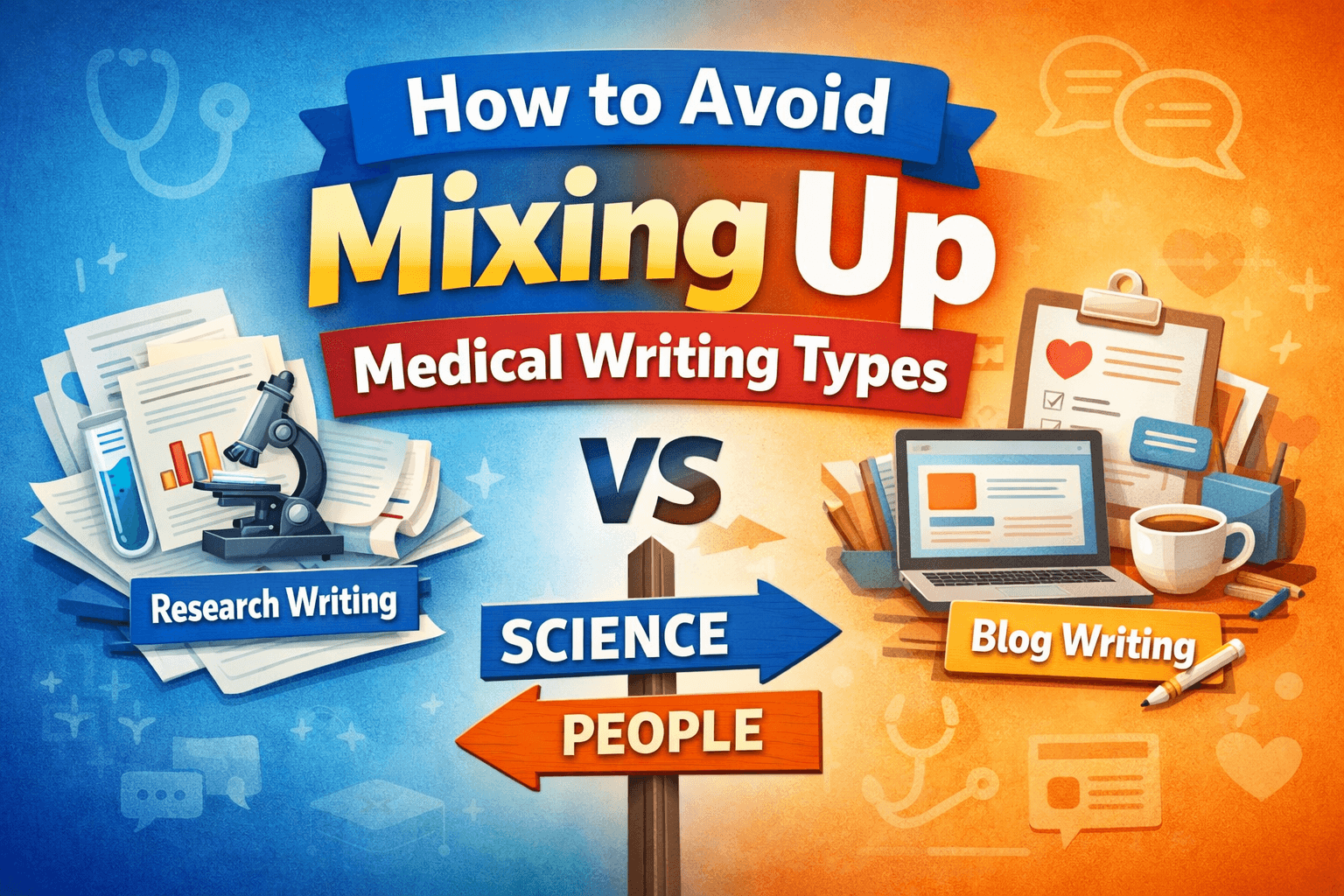
As a medical professional transitioning into a nonclinical career, various doubts arise. Since everyone has dedicated their late teens to becoming a doctor, exploring such a different career could be frightening. But what if they don’t understand the basic difference between medical research writing and medical content writing? I made the same mistake, so make sure that you don’t.
Medical research writing is the writing done for professionals to know about your expertise.
It requires a unique set of skills where a complex subject is addressed.
Here, the audience is researchers, physicians, journal publishers, etc.
The tone of writing would be more formal and professional.
It requires knowledge regarding regulatory guidelines, study design, statistics, and a deep understanding of the field.
It requires multiple hours and days spent to publish a single article, which undergoes multiple processes of rewrites and peer review.
Each paper published would increase your credibility within your field.
The formats include research papers, journals, peer-reviewed articles, systematic and meta-analyses, etc.
The accuracy and precision decide the level of authenticity of your work.
Plagiarism is monitored at an extreme level so that the same research is not done twice.
Researchers submit their works to different publishers based on the criteria of the journal.
Usually done by freelancing or under publishers.
Example: The study has slight significance with a P value < 0.05.
Medical content writing is all about delivering medical content to non-medical people.
Complex medical terms are delivered in simple terms so that anyone can understand your content and gain knowledge.
Here, the audience is non-medical individuals who have no idea about the nuances of the medical field. It is usually patients, the general public, healthcare consumers, and even clinicians,s sometimes.
The tone of writing would be more conversational and friendly, simplifying the explanations while educating the audience.
It requires knowledge regarding SEO, narrative flow, breaking down complex subjects into simpler formats, etc.
It requires less time to produce a single post and may not undergo a vigorous review every time.
Each piece of content published would help you gain experience.
The formats include blogs, patient education pamphlets, posters, social media content, web articles, etc.
Creative and unique posts regarding unknown facts are often handpicked by the audience.
Plagiarism is monitored, but not as much as research papers.
Posts and content should satisfy the client.
Usually done for a particular company that requires their expertise to promote their website or social media.
Example: Diabetes is caused by excessive sugar content in the blood.
This is a brief explanation regarding the key differences between medical research writing and medical content writing. Choosing the path you want to pursue is based on your skill sets and passion to thrive. The world is competitive, and we must choose the right path, which will determine our future.
As a medical professional transitioning into a nonclinical career, various doubts arise. Since everyone has dedicated their late teens to becoming a doctor, exploring such a different career could be frightening. But what if they don’t understand the basic difference between medical research writing and medical content writing? I made the same mistake, so make sure that you don’t.
Medical research writing is the writing done for professionals to know about your expertise.
It requires a unique set of skills where a complex subject is addressed.
Here, the audience is researchers, physicians, journal publishers, etc.
The tone of writing would be more formal and professional.
It requires knowledge regarding regulatory guidelines, study design, statistics, and a deep understanding of the field.
It requires multiple hours and days spent to publish a single article, which undergoes multiple processes of rewrites and peer review.
Each paper published would increase your credibility within your field.
The formats include research papers, journals, peer-reviewed articles, systematic and meta-analyses, etc.
The accuracy and precision decide the level of authenticity of your work.
Plagiarism is monitored at an extreme level so that the same research is not done twice.
Researchers submit their works to different publishers based on the criteria of the journal.
Usually done by freelancing or under publishers.
Example: The study has slight significance with a P value < 0.05.
Medical content writing is all about delivering medical content to non-medical people.
Complex medical terms are delivered in simple terms so that anyone can understand your content and gain knowledge.
Here, the audience is non-medical individuals who have no idea about the nuances of the medical field. It is usually patients, the general public, healthcare consumers, and even clinicians,s sometimes.
The tone of writing would be more conversational and friendly, simplifying the explanations while educating the audience.
It requires knowledge regarding SEO, narrative flow, breaking down complex subjects into simpler formats, etc.
It requires less time to produce a single post and may not undergo a vigorous review every time.
Each piece of content published would help you gain experience.
The formats include blogs, patient education pamphlets, posters, social media content, web articles, etc.
Creative and unique posts regarding unknown facts are often handpicked by the audience.
Plagiarism is monitored, but not as much as research papers.
Posts and content should satisfy the client.
Usually done for a particular company that requires their expertise to promote their website or social media.
Example: Diabetes is caused by excessive sugar content in the blood.
This is a brief explanation regarding the key differences between medical research writing and medical content writing. Choosing the path you want to pursue is based on your skill sets and passion to thrive. The world is competitive, and we must choose the right path, which will determine our future.
As a medical professional transitioning into a nonclinical career, various doubts arise. Since everyone has dedicated their late teens to becoming a doctor, exploring such a different career could be frightening. But what if they don’t understand the basic difference between medical research writing and medical content writing? I made the same mistake, so make sure that you don’t.
Medical research writing is the writing done for professionals to know about your expertise.
It requires a unique set of skills where a complex subject is addressed.
Here, the audience is researchers, physicians, journal publishers, etc.
The tone of writing would be more formal and professional.
It requires knowledge regarding regulatory guidelines, study design, statistics, and a deep understanding of the field.
It requires multiple hours and days spent to publish a single article, which undergoes multiple processes of rewrites and peer review.
Each paper published would increase your credibility within your field.
The formats include research papers, journals, peer-reviewed articles, systematic and meta-analyses, etc.
The accuracy and precision decide the level of authenticity of your work.
Plagiarism is monitored at an extreme level so that the same research is not done twice.
Researchers submit their works to different publishers based on the criteria of the journal.
Usually done by freelancing or under publishers.
Example: The study has slight significance with a P value < 0.05.
Medical content writing is all about delivering medical content to non-medical people.
Complex medical terms are delivered in simple terms so that anyone can understand your content and gain knowledge.
Here, the audience is non-medical individuals who have no idea about the nuances of the medical field. It is usually patients, the general public, healthcare consumers, and even clinicians,s sometimes.
The tone of writing would be more conversational and friendly, simplifying the explanations while educating the audience.
It requires knowledge regarding SEO, narrative flow, breaking down complex subjects into simpler formats, etc.
It requires less time to produce a single post and may not undergo a vigorous review every time.
Each piece of content published would help you gain experience.
The formats include blogs, patient education pamphlets, posters, social media content, web articles, etc.
Creative and unique posts regarding unknown facts are often handpicked by the audience.
Plagiarism is monitored, but not as much as research papers.
Posts and content should satisfy the client.
Usually done for a particular company that requires their expertise to promote their website or social media.
Example: Diabetes is caused by excessive sugar content in the blood.
This is a brief explanation regarding the key differences between medical research writing and medical content writing. Choosing the path you want to pursue is based on your skill sets and passion to thrive. The world is competitive, and we must choose the right path, which will determine our future.
Explore Topics

0%
Explore Topics
0%