

The bizzare truth behind medieval tooth pain
Could worms be the cause of tooth pain?
Published On:
Last Updated On:
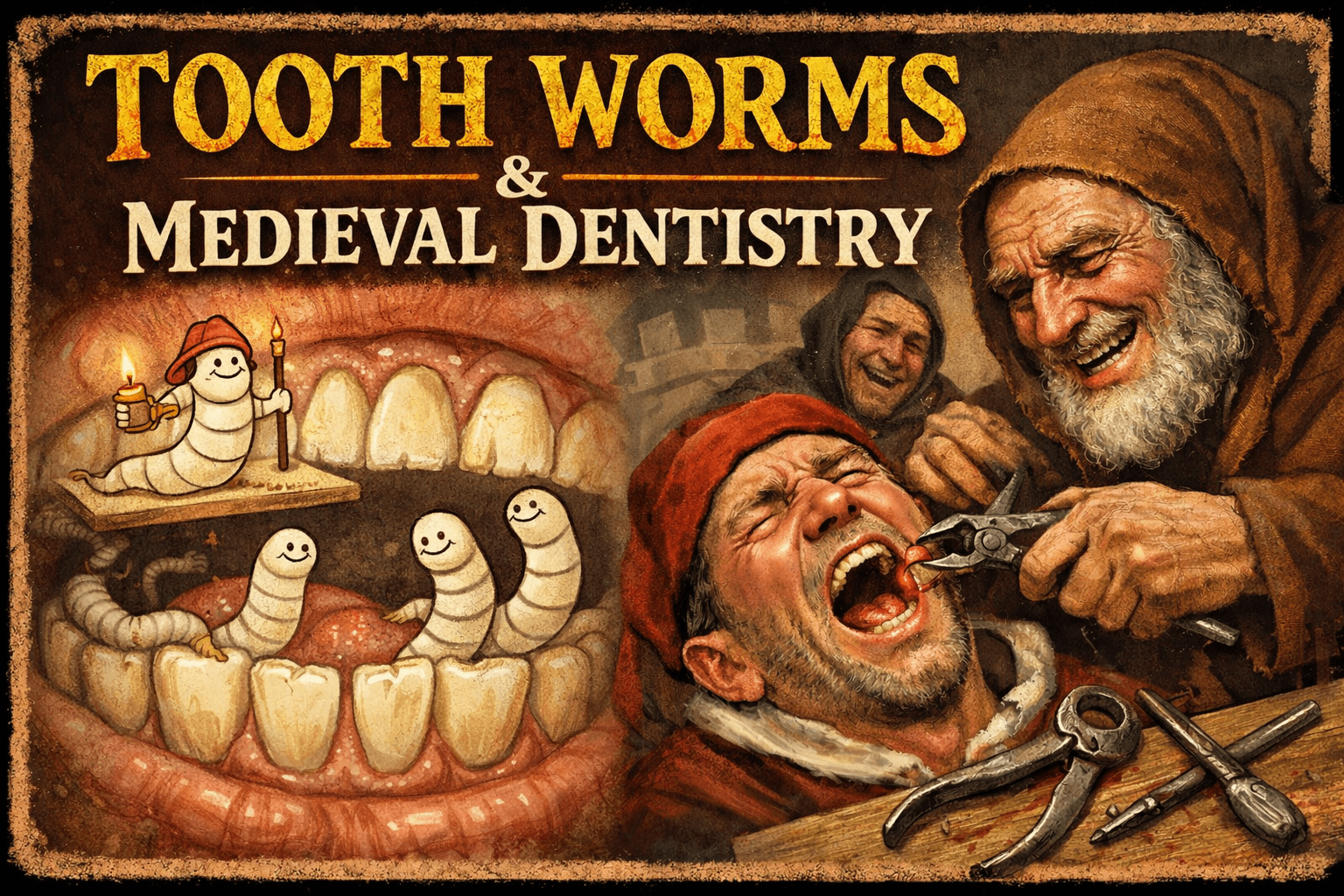
Imagine this: you are in the medieval ages and experiencing tooth pain. You visit the local healer, who diagnoses you with tooth worms. Yes, literal worms wiggling inside your tooth, causing the unbearable pain. Seems something from a black mirror episode, right?. Welcome to the fascinating—and slightly horrifying—world of medieval dentistry.
The tooth worm theory was a common misbelief thought to be true by various ancient civilizations, including the Sumerians, Egyptians, Germans, and Greeks. Evidence has been found as far back as 2000 BCwithescribing various ways to kill these worms by medical herbs. It was thought that these worms lived inside our tooth, feeding on the food we eat,e and caused pain while they wiggle and grow and die when they come in contact with the air. It was even linked to the cause of headaches.
Medical salves - Cloves, Honey and garlic were thought to subjugate these worms. It did work, as later it was. found to have an analgesic and soothing effect
Spells - Various spells were practiced to mitigate this problem
“Pear tree, I complain to you, three worms are gnawing me, one is gray and the other one is blue, the third one is red, I wish, all three were dead… While reciting the verses one touched the tree and turned three times around it clockwise”
Oaths - Even oaths were taken to expel these worms
“Vor die Würme in Zeenen. Ein wunderlich/vnd doch wahrhafftig/Kunststücklein. Schneide von einem jungen Weidenen stamme/die öbere rinde weg/vnd schneide darunter einen span heraus/ stöchere die Zeene damit/das sie bluten/vnd las das blut am Span trucken oder treuge werden. Darnach gehe hin vnd setze den Span fein wider ein/wie du in aus der Weide genomen/lege die Rinde wider drüber/vnd binde es mit weichen Lehme zu/so vergeht dich die wehetage. Est vera cura, vnd ist keine Zauberey” -Text published in 1604
Incense and prayers - Incenses wewas re burne,d and inhaling these medicinal herbs thought to help
Extraction - Removal of the tooth can help in the removal of the problem oofthe worms.
This theory held strong until the 17th century, when scientists discovered the real culprit: bacteria producing acids that erode enamel. This led to the discovery of t the field of dentistry and various aspects including filling, root canjal treatment etc.
But medieval dentistry wasn’t entirely useless. Some herbal remedies, like clov.e oil, actually have real medicinal properties
Fun Fact:
In some parts of India and Africa, the tooth worm myth persisted well into the 19th century.
Imagine this: you are in the medieval ages and experiencing tooth pain. You visit the local healer, who diagnoses you with tooth worms. Yes, literal worms wiggling inside your tooth, causing the unbearable pain. Seems something from a black mirror episode, right?. Welcome to the fascinating—and slightly horrifying—world of medieval dentistry.
The tooth worm theory was a common misbelief thought to be true by various ancient civilizations, including the Sumerians, Egyptians, Germans, and Greeks. Evidence has been found as far back as 2000 BCwithescribing various ways to kill these worms by medical herbs. It was thought that these worms lived inside our tooth, feeding on the food we eat,e and caused pain while they wiggle and grow and die when they come in contact with the air. It was even linked to the cause of headaches.
Medical salves - Cloves, Honey and garlic were thought to subjugate these worms. It did work, as later it was. found to have an analgesic and soothing effect
Spells - Various spells were practiced to mitigate this problem
“Pear tree, I complain to you, three worms are gnawing me, one is gray and the other one is blue, the third one is red, I wish, all three were dead… While reciting the verses one touched the tree and turned three times around it clockwise”
Oaths - Even oaths were taken to expel these worms
“Vor die Würme in Zeenen. Ein wunderlich/vnd doch wahrhafftig/Kunststücklein. Schneide von einem jungen Weidenen stamme/die öbere rinde weg/vnd schneide darunter einen span heraus/ stöchere die Zeene damit/das sie bluten/vnd las das blut am Span trucken oder treuge werden. Darnach gehe hin vnd setze den Span fein wider ein/wie du in aus der Weide genomen/lege die Rinde wider drüber/vnd binde es mit weichen Lehme zu/so vergeht dich die wehetage. Est vera cura, vnd ist keine Zauberey” -Text published in 1604
Incense and prayers - Incenses wewas re burne,d and inhaling these medicinal herbs thought to help
Extraction - Removal of the tooth can help in the removal of the problem oofthe worms.
This theory held strong until the 17th century, when scientists discovered the real culprit: bacteria producing acids that erode enamel. This led to the discovery of t the field of dentistry and various aspects including filling, root canjal treatment etc.
But medieval dentistry wasn’t entirely useless. Some herbal remedies, like clov.e oil, actually have real medicinal properties
Fun Fact:
In some parts of India and Africa, the tooth worm myth persisted well into the 19th century.
Imagine this: you are in the medieval ages and experiencing tooth pain. You visit the local healer, who diagnoses you with tooth worms. Yes, literal worms wiggling inside your tooth, causing the unbearable pain. Seems something from a black mirror episode, right?. Welcome to the fascinating—and slightly horrifying—world of medieval dentistry.
The tooth worm theory was a common misbelief thought to be true by various ancient civilizations, including the Sumerians, Egyptians, Germans, and Greeks. Evidence has been found as far back as 2000 BCwithescribing various ways to kill these worms by medical herbs. It was thought that these worms lived inside our tooth, feeding on the food we eat,e and caused pain while they wiggle and grow and die when they come in contact with the air. It was even linked to the cause of headaches.
Medical salves - Cloves, Honey and garlic were thought to subjugate these worms. It did work, as later it was. found to have an analgesic and soothing effect
Spells - Various spells were practiced to mitigate this problem
“Pear tree, I complain to you, three worms are gnawing me, one is gray and the other one is blue, the third one is red, I wish, all three were dead… While reciting the verses one touched the tree and turned three times around it clockwise”
Oaths - Even oaths were taken to expel these worms
“Vor die Würme in Zeenen. Ein wunderlich/vnd doch wahrhafftig/Kunststücklein. Schneide von einem jungen Weidenen stamme/die öbere rinde weg/vnd schneide darunter einen span heraus/ stöchere die Zeene damit/das sie bluten/vnd las das blut am Span trucken oder treuge werden. Darnach gehe hin vnd setze den Span fein wider ein/wie du in aus der Weide genomen/lege die Rinde wider drüber/vnd binde es mit weichen Lehme zu/so vergeht dich die wehetage. Est vera cura, vnd ist keine Zauberey” -Text published in 1604
Incense and prayers - Incenses wewas re burne,d and inhaling these medicinal herbs thought to help
Extraction - Removal of the tooth can help in the removal of the problem oofthe worms.
This theory held strong until the 17th century, when scientists discovered the real culprit: bacteria producing acids that erode enamel. This led to the discovery of t the field of dentistry and various aspects including filling, root canjal treatment etc.
But medieval dentistry wasn’t entirely useless. Some herbal remedies, like clov.e oil, actually have real medicinal properties
Fun Fact:
In some parts of India and Africa, the tooth worm myth persisted well into the 19th century.
Explore Topics

0%
Explore Topics
0%