Myocardial infarction refers to the irreversible necrosis of the heart myocytes. It leads to impaired cardiac function due to obstruction of the coronary artery, leading to inability to supply the increased demand.
MI is typically categorized based on ECG changes, especially the ST phase, as:
ST-elevation myocardial infarction (STEMI) – usually due to complete coronary occlusion
Non-ST-elevation myocardial infarction (NSTEMI) – usually due to partial occlusion
Coronary Atherosclerosis: The Underlying Substrate
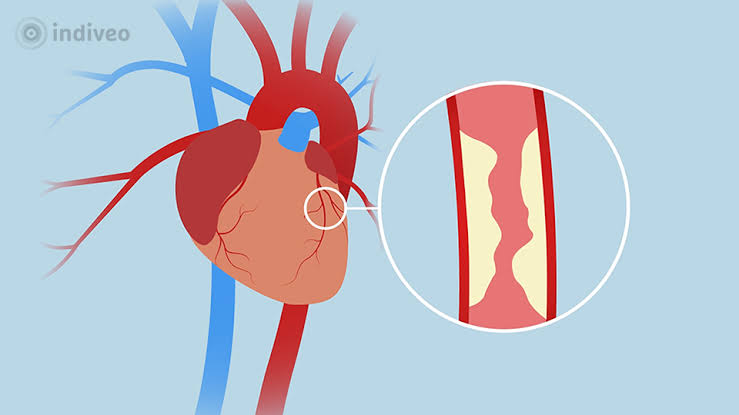
Atherosclerotic plaques occluding the coronary arteries are responsible for the ischemic necrosis of the heart.
A. Endothelial Dysfunction
Endothelial damage occurs due to various factors, such as:
Smoking
Diabetes
Hypertension
Hyperlipidemia
Endothelial dysfunction leads to:
Increased permeability of LDL through the basement membrane
Recruitment of monocytes and platelets
Increased cellular adhesion
B. Fatty Streak Formation
LDL becomes oxidized in the intima.
Monocytes differentiate into macrophages.
Lipid-laden macrophages (foam cells) accumulate, forming fatty streaks.
C. Fibrous Plaque Formation
Smooth muscle cells migrate from the media to the intima and proliferate. They synthesize extracellular matrix components (collagen and proteoglycans), forming a fibrous cap over a lipid-rich necrotic core.
Stable plaques have thick fibrous caps. Vulnerable plaques have thin caps and large lipid cores, predisposing them to rupture.
2. Platelet Aggregation and Thrombus Formation
This is the most critical part of the mechanism.
A. Plaque Disruption
Mechanical stress and inflammatory degradation of the fibrous cap (via macrophage-derived metalloproteinases) cause rupture. This exposes highly thrombogenic materials, such as:
B. Platelet Activation
Exposure of subendothelial collagen leads to:
Platelet adhesion
Platelet activation
Release of ADP and thromboxane A₂
Platelet aggregation
C. Coagulation Cascade Activation
Tissue factor activates the extrinsic pathway of coagulation, resulting in thrombin generation and fibrin formation.
A thrombus forms, which may:
Partially occlude the vessel (NSTEMI)
Completely occlude the vessel (STEMI)
4. Myocardial Ischemia and Cellular Injury
Once coronary blood flow decreases significantly:
A. Oxidative Stress and Mitochondrial Dysfunction
Acute ischemic phase → Interruption of oxygen supply to the myocardium → Impaired mitochondrial electron transport chain (ETC) function → Overproduction of superoxide anions.
B. Metabolic Changes (Within Seconds)
Aerobic metabolism ceases.
ATP production declines.
Cells switch to anaerobic glycolysis.
Lactate accumulates, causing intracellular acidosis.
C. Loss of Contractility (Within 60 Seconds)
Reduced ATP impairs:
Actin–myosin cross-bridge cycling
Calcium handling
This results in early systolic dysfunction.
D. Ionic Pump Failure
ATP depletion disrupts:
Consequences:
Intracellular Na⁺ accumulation
Calcium overload
Cellular swelling
5. Progression to Irreversible Injury
If ischemia persists beyond approximately 20–40 minutes:
Mitochondrial dysfunction becomes irreversible.
Sarcolemmal membrane integrity is lost.
Cell necrosis occurs.
Necrotic myocytes release intracellular proteins into circulation, including:
Cardiac troponin I and T (most specific markers)
CK-MB
6. Wavefront Phenomenon of Necrosis
In a complete occlusion (STEMI), necrosis progresses from:
Subendocardium (most vulnerable due to highest oxygen demand and lowest perfusion pressure)
Toward the epicardium
This transmural progression may take several hours.
7. Inflammatory Response and Healing
A. Acute Inflammatory Phase (0–3 days)
Neutrophils infiltrate necrotic tissue.
Cytokines amplify inflammation.
Myocardium is structurally weakened.
B. Macrophage Phase (3–7 days)
Macrophages remove necrotic debris.
Risk of myocardial rupture is highest during this period.
C. Granulation and Scar Formation (Weeks)
Fibroblasts proliferate.
Collagen deposition replaces necrotic myocardium.
Permanent fibrotic scar forms (non-contractile).
8. Reperfusion Injury
Restoration of blood flow is essential but may paradoxically cause additional injury due to:
Reactive oxygen species
Calcium overload
Inflammatory activation
Clinically, this may manifest as reperfusion arrhythmias.
9. Hemodynamic and Electrical Consequences
MI can lead to:
Reduced stroke volume and cardiac output
Cardiogenic shock (if a large territory is involved)
Ventricular arrhythmias
Heart failure
Mechanical complications (papillary muscle rupture, septal rupture, free wall rupture)
10. Summary of Pathophysiologic Sequence
Endothelial dysfunction → atherosclerotic plaque
Plaque rupture → platelet activation and thrombus formation
Coronary occlusion → myocardial ischemia
ATP depletion → ionic imbalance → necrosis
Inflammation → scar formation
Permanent loss of contractile myocardium
Clinical Correlation
In STEMI, complete occlusion produces transmural infarction with ST-segment elevation on ECG. In NSTEMI, partial occlusion produces subendocardial infarction without ST elevation.
Early reperfusion therapy (e.g., PCI or thrombolysis) aims to interrupt this pathophysiologic cascade and preserve viable myocardium.
References
Robbins & Cotran Pathologic Basis of Disease. Kumar V, Abbas AK, Aster JC. Elsevier; 2020.
Braunwald’s Heart Disease: A Textbook of Cardiovascular Medicine. Zipes DP, Libby P, Bonow RO, Mann DL, Tomaselli GF, editors. Elsevier; 2021.
Thygesen K, Alpert JS, Jaffe AS, et al. Fourth Universal Definition of Myocardial Infarction (2018). European Society of Cardiology / American College of Cardiology / American Heart Association / World Heart Federation. Circulation. 2018;138:e618–e651.
American Heart Association. 2023 AHA/ACC Guideline for the Management of Acute Coronary Syndromes. Circulation. 2023.